 Non classé
Animus launches animal behavior tracking with little to adjust
Every behavioral neuroscience lab knows the two moments when video tracking hurts: the afternoon spent adjusting a threshold until the numbers look right, and the day a reviewer asks how exactly immobility was defined. A new company, Animus, launches this autumn with a station designed around those two moments. It is delivered set up, it runs from anywhere, and it is paid by the year rather than bought.
Less to adjust
Most animal behavior tracking tools arrive as software. The lab then finds a camera, a PC, the right lighting, a background that contrasts with the coat colour, and someone with time to tune detection for each arena. Published comparisons of the leading packages show that this tuning is where results start to diverge between labs: the same animal, two set-ups, different distances.
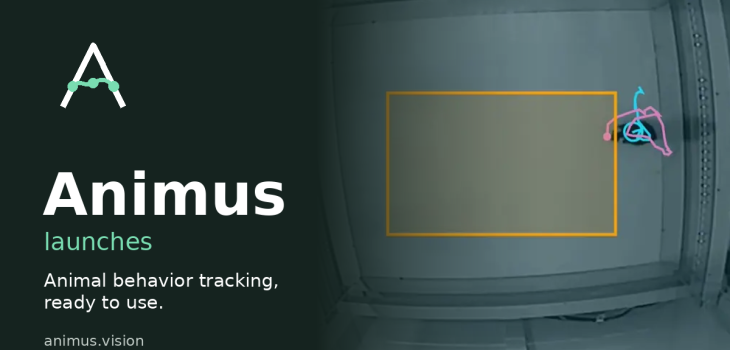
Animus takes the other road: a closed capture station with its own infrared camera, delivered with the analysis already running on it. The approach is to take the variables out of the room, lighting, background, camera placement, so that less is left to the person on duty. The arena is recognised on the live image and adjusted in a few clicks. The company’s stated goal is a station that arrives set up and stays that way.
Measures one can explain
The second ambition is that every number in a report can be traced back to how it was obtained. The measures are documented, with their definitions and default parameters, in the online guide that comes with the station: the entry criterion, the immobility threshold and minimum bout, the analysis window, the zone geometry. The company says it intends to keep publishing, as they are measured, how its measures compare with manual scoring, rather than asking labs to take them on trust. A manual-scoring tool is already part of the software for labs that want to check for themselves.
For laboratories working under GLP or 21 CFR Part 11, the station keeps an audit trail and comes with its own IQ/OQ/PQ validation dossier, included rather than sold as a premium tier.
Run the experiment from anywhere
The station sits in the animal room; the researcher does not have to. From any PC, in the office, at home or at a conference, the experiment is prepared, the arena is checked on the live image, the test is started and stopped, and the results are read, all in a shared workspace where the whole team sees the same thing. A colleague can look at a running test without entering the room, and a supervisor can review the morning session from another city. Fewer people walk in and out of the room during a test, and experiments no longer wait for the one person who knows the software to be on site.
Results at the end of the test
The measurements labs use every day are produced while the animal is still in the arena: distance travelled, time spent in each zone, immobility, entries and latencies. When the test stops, the report, the track plot and the CSV export are there. No overnight batch, no second pass on the video.
For video tracking of mice and rats, the standard tests are supported out of the box: the open field test, elevated plus maze, forced swim, Morris water maze, Y maze, light/dark box, novel object recognition, three-chamber and Barnes maze. Zebrafish larvae in multi-well plates and adults are covered by the same station. Recordings stay in the lab, on the station.
“We wanted the first experiment to run the day the station arrives, with nobody from IT in the room.” — the Animus team
A yearly subscription instead of a capital purchase
The established packages are sold as perpetual licences that run to several thousand euros, hardware apart, with modules on top for a second arena or for compliance. Animus is sold as a yearly subscription: €1,200 a year for the Lab offer, with the capture station, the infrared camera, the software, its updates and support included, and no seat count: the whole team reads and analyses. There is nothing else to buy to run an open field or an elevated plus maze, and nothing to own that ages.
Labs can try the complete setup for 15 days for €300 before committing, with the equipment in their own room and their own animals. For those comparing, the company keeps a comparison of animal behavior tracking software prices up to date on its site, with sources and dates.
What comes next
Rodents and zebrafish are the first markets. The company says the same approach, a station set up on arrival, measures documented and checked against manual scoring, run from a distance, will be extended to other models over the coming months.
Behavioral researchers who want to see it on their own arena can book a demo or request a lab trial on the Animus website.

